
Guide · NYC Property Managers
NYC Water Bill Reduction Guide for Property Managers
A practical walkthrough of how NYC building managers audit DEP bills, identify air-driven overcharges, and lock in 20%+ savings — using the Fulton Avenue building as a real-world example.
Why NYC water bills run high
NYC DEP bills the property for everything that crosses the meter — including compressed air that gets pushed through the service line at high pressure. In older buildings, air pockets form whenever the main is shut down, hydrants are flushed, or pressure swings overnight. When water returns, the meter spins on that air the same way it spins on water. The bill goes up; consumption, from a tenant perspective, does not.
For property managers, the symptom is familiar: a building's per-unit usage creeps up year over year, leak inspections come back clean, and DEP confirms the meter is "accurate." It usually is — accurate, and measuring air.
A 3-step audit for property managers
- Pull 24 months of actual-read DEP statements. Estimated reads hide the pattern. Plot gallons per day per unit — spikes that don't line up with occupancy changes are the tell.
- Check the service line pressure profile. Properties on high-pressure mains (most of Manhattan, the Bronx, and Western Queens) are the most affected. A simple gauge at the meter over 48 hours shows the swings.
- Install an air-removal valve at the meter. A Flumera valve compresses trapped air before it reaches the meter, so DEP only bills actual water. No tenant disruption, no metering changes, no DEP filing.
Case study: Fulton Avenue, Brooklyn
Fulton Avenue is the clearest data point we have for an NYC multifamily building. After installation, 73 consecutive days of DEP actual-read data showed a 22.7% reduction in billed water — roughly 96,895 gallons saved, projecting to about $8,400 per year in avoided DEP and sewer charges on a single building.
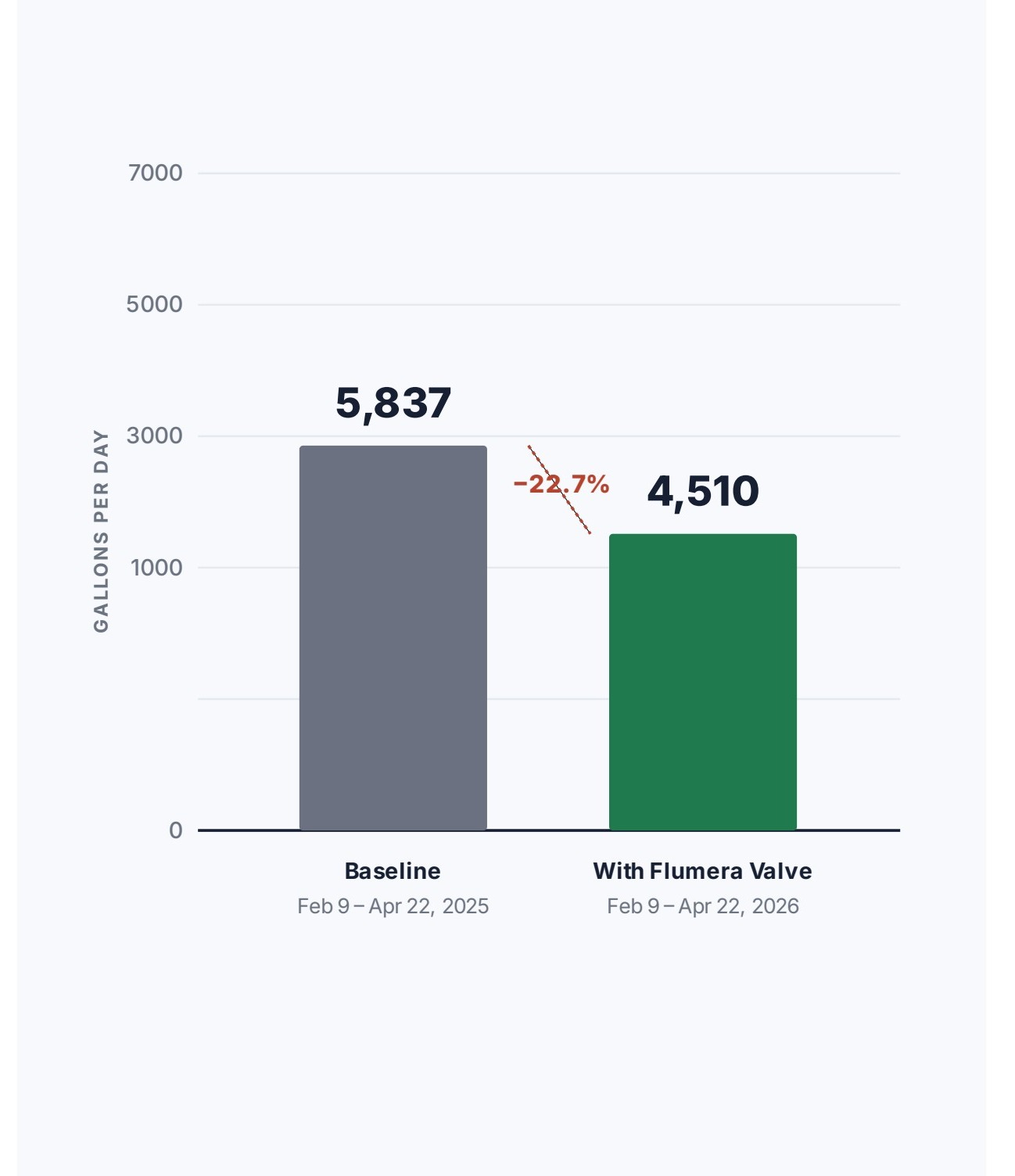
The building manager didn't change tenant behavior, didn't replace fixtures, and didn't renegotiate with DEP. The valve compressed the air the building was already paying for, and the meter started reading water only.
What to do this quarter
- Pull 24 months of actual-read DEP bills for each property in your portfolio.
- Flag any building running above 55 gallons per day per occupant — that's the air-overcharge band.
- Request a no-cost savings analysis; we'll model expected reduction from your DEP data before any install.
Run the numbers on your building
Send us your last 24 months of DEP statements. We'll project your savings before you commit to anything.
Request a free savings analysis